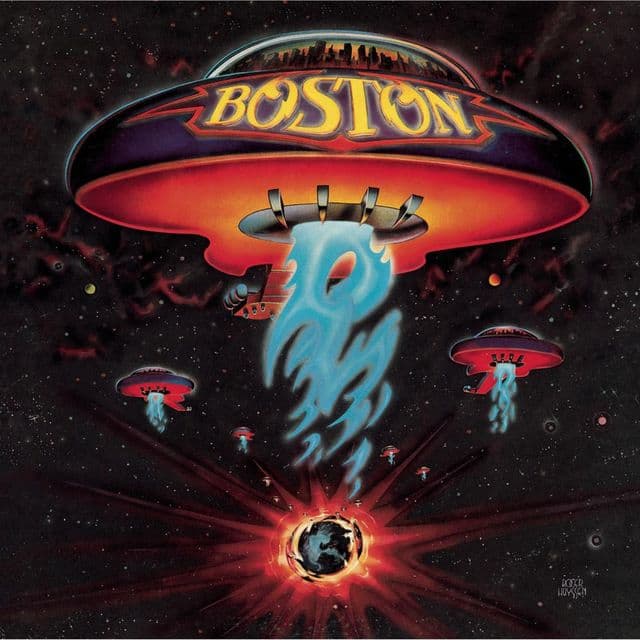
The Basement Myth That Was True
How Tom Scholz secretly built rock's best-selling debut — and let Epic tell the world it happened in Los Angeles
In the mid-1970s, record labels loved to plant stories about their artists that sounded too good to be true. Boston's debut album came with the opposite problem: the label spent real effort making sure nobody believed the story that actually happened. Epic Records told the press its new hard-rock band had cut a polished, professional record in a proper Los Angeles studio. The truth was stranger and far more impressive — a Polaroid engineer named Tom Scholz had built almost the entire thing alone, at night, in the basement of a rented house in Watertown, Massachusetts, on a tape machine he'd bought with his own salary. For decades, the record that would become one of the best-selling debut albums in American history was hiding a secret its own label had constructed.
The Engineer Who Didn't Trust Studios
Tom Scholz was not supposed to be a rock star. He held a master's degree in mechanical engineering from MIT and spent his days at Polaroid designing camera mechanisms — a career, not a day job he was waiting to escape. Music was something he pursued on his own time and his own dime, and by the mid-1970s he had already sunk years of an engineer's salary into it, much of it wasted on studio time that never produced anything he could sell.
So he stopped paying for other people's studios and built his own. Working nights and weekends, he assembled a home rig around a Scully 12-track tape recorder and a Dan Flickinger mixing console, then solved a problem no one had asked him to solve: how to record a cranked Marshall amplifier at a volume that wouldn't get him evicted. His answer was a resistor-based attenuator built from theatrical lighting parts — a device he later patented and sold commercially as the Power Soak.
"I started around 1969. From there it was a long, long string of doing everything from buying time in so-called professional recording studios… That whole process took until 1975… I'd been spending money for six years in pretty large quantities."
Twenty-Four Rejections and One Kept Letter
Scholz sent his basement recordings to label after label, and label after label passed. He has never forgotten the tally, and he has never forgotten the executive who later tried to take credit anyway. One Epic Records A&R man publicly claimed to have championed the band from the start — a claim Scholz still keeps physical proof against.
“I understand Lenny has been very quick to mention in public that he was a big part of us getting signed to Epic Records,” Scholz said, “so I always keep the letter that he signed, saying that they had no interest.” It is a small detail, but it captures the whole shape of the story to come: an industry that dismissed Scholz right up until the moment it needed to pretend it had believed in him all along.
An Offer With a Catch
When Epic finally signed the band — formerly called Mother's Milk, renamed Boston at producer John Boylan's suggestion — the deal came with a contractual wall Scholz couldn't get around by talent alone. Epic's contract required union-approved engineers working in professional facilities. His actual recordings had been made on his own equipment, off the clock, with no union card in sight.
Boylan's solution was less a compromise than a con job aimed at his own employer. He proposed that Scholz keep working exactly as he had been — alone, in the basement — while the label was allowed to believe otherwise entirely.
"John Boylan, the producer Epic chose, offered me a deal. I would make the record in my basement and wouldn't tell anybody… Epic would think all the recording was done in LA."
Boylan described his own job on the project in equally plain terms: to run interference for the label and keep everyone happy while the actual work happened three thousand miles from where anyone at Epic thought it was happening.
Building the Illusion in Hollywood
To sell the fiction, the rest of the band flew to Los Angeles while Scholz kept recording at home. His finished guitar, bass, and keyboard tracks were shipped west by way of a remote recording truck out of Providence, transferred from his basement tape onto professional 24-track reels so they could plausibly claim a studio pedigree. Singer Brad Delp re-cut his lead vocals at Capitol Studios' Studio C in Hollywood, through a Neumann U87 microphone into a real Quad Eight console — genuine studio work, layered on top of a genuinely homemade record.
Some of the illusion produced accidental magic. The hand-claps heard on “More Than a Feeling” were recorded not on a soundstage but in the Capitol Studios men's room, chosen, Boylan said, simply “because it had such a cool sound.” Final mixing happened at Westlake Studios on Wilshire Boulevard, on a manual board with no automation — meaning every fader move that blended five months of basement tape into a seamless whole had to be performed live, by hand, take after take.
Two Men, One Mix, and a Tug-of-War
The arrangement did not run smoothly. Boylan, an experienced session producer, found Scholz's command of live instruments far shakier than his command of a guitar solo. “Tom was an obvious genius,” he said, “but he didn't know how to record acoustic instruments. The drums and acoustic guitars were amateurish.” The two men fought quietly over the mix itself, each pulling the record toward a different idea of what it should sound like.
"It was a tug-of-war in the beginning… Tom is pushing the guitars up unceasingly."
Even the Hollywood cover story eventually buckled under Los Angeles itself. A handful of Delp's vocal overdubs stalled because his voice struggled in the city's smog, so the band abandoned the charade mid-session and drove back to Massachusetts to finish them in the same basement the whole record had supposedly left behind.
A Secret That Outlasted the Album's Success
Released on August 25, 1976, Boston went gold within about three weeks and platinum within roughly eleven weeks — reportedly the fastest climb to platinum by an American act's debut up to that point. It eventually sold past 17 million copies in the United States alone. None of the millions of people buying it knew they were holding a record whose liner-note glamour was, by design, a misdirection from its actual origin.
The truth surfaced slowly, mostly through Scholz himself, who grew more open about the basement sessions in interviews across the following decades. What could have read as an embarrassing admission — that a landmark rock record wasn't made the way the label said it was — instead became the album's most durable legend, more compelling than the studio-glamour version Epic had tried to sell in the first place.
The Perfectionism That Never Left
Scholz never really stopped being the engineer who couldn't trust anyone else's studio, or anyone else's timeline. Every subsequent Boston album arrived years, sometimes a full decade, after the one before it — the same obsessive standard that built the first record in a basement kept rebuilding every record after it from scratch.
"I've spent six months making a recording of a song that I've thrown out… It's just something that I have to do. I have to do it the best I can do it."
Fifty years later, the version of the story Epic tried to bury is the only one anyone tells. A record built to sound like it came from a professional Hollywood studio turned out to be more remarkable for having come from nowhere near one — a rented basement, a homemade attenuator, and a man who kept going to his day job at Polaroid the whole time he was building the best-selling debut album in rock history.